
Small Claims Court Guide: When to Use It and What to Expect
Last updated: August 11, 2026
- Key facts – Small claims is usually for simple money disputes , not injunctions or complex fraud claims.
- – Every jurisdiction sets its own dollar or pound limit for small claims.
- When Small Claims Court Is the Right Tool A modest amount.
- Quick check: For “get paid back or pay someone a fixed amount,” small claims may fit.
Quick answer: For a straightforward money dispute, small claims court is usually the best fit when the amount is modest and the facts are plain. This small claims court guide: when use it what expect explains the process in general terms, but rules vary by jurisdiction, and this is general information, not legal advice; a qualified lawyer should be consulted about your own situation.
Key facts
– Small claims is usually for simple money disputes, not injunctions or complex fraud claims.
– Every jurisdiction sets its own dollar or pound limit for small claims.
– You usually need to serve the defendant properly before the case can move forward.
– A judgment is not always paid voluntarily, so collection rules may matter after you win.
– If the dispute has multiple legal issues or expert evidence, a regular civil case may fit better.
A landlord deposit argument. An unpaid invoice. A damaged item. Those are the kinds of fights that tend to land here. Small claims court is usually the right place for a straightforward money dispute that is too small to justify a full lawsuit. For an unpaid bill, a damaged item, a landlord deposit fight, or a simple contract dispute, this small claims court guide: when use it what expect will help you decide whether small claims court fits—and what the process usually looks like. Rules vary by jurisdiction, so I’m describing the process in general terms, and this is general information, not legal advice; a qualified lawyer should be consulted about your own situation.
When Small Claims Court Is the Right Tool
A modest amount. That is the starting point. For a relatively small sum of money back, small claims court is often the first place I would look. The whole point is speed and simplicity. Small claims court is usually not what you want if you need an injunction, a complex fraud claim, a business breakup, or a legal fight that depends on a lot of expert evidence. Those cases tend to belong in a higher court or in a different process entirely.
When the other side owes you money and the facts are simple—“I paid, they didn’t deliver,” “they damaged my car,” “they kept my deposit without a good reason”—small claims is often built for that kind of dispute. But once the story turns into a long relationship, a tangled contract, or several legal questions at once, the fit gets worse. Fast. The court can feel like a shoebox.
Here’s the core decision table I would use:
| Situation | Best Path | Why Other Options Fail |
|---|---|---|
| Clear money dispute with simple facts | Small claims court | A lawyer-driven lawsuit may cost more than the claim is worth |
| Need an order to stop someone from doing something | Higher court or different remedy | Small claims usually focuses on money, not broader court orders |
| Heavy document review or expert evidence | Full civil process | Small claims is designed to be streamlined |
| You mainly want fast negotiation | Demand letter, mediation, settlement talk | Court is slower and more formal than many people expect |
For people who want a straight, no-drama process, small claims can fit well. If you need a big legal theory or expect the dispute to turn on technical arguments, it may not.
Quick check: For “get paid back or pay someone a fixed amount,” small claims may fit. For “make them stop” or “sort out a complicated legal mess,” it probably does not.
The 3 Conditions That Change Everything
Three things matter more than anything else: the amount in dispute, what the law in your jurisdiction allows in small claims, and whether the other side can actually be served and made to show up.
First, the amount. Every jurisdiction sets its own ceiling. Some systems have low caps; others are higher. I am not going to give you a universal number because there isn’t one. For a claim over the limit, small claims may not be available.
Second, the kind of claim. Some places let you bring only certain disputes. Others exclude things like defamation, family law, or claims that ask for more than money. Read the local court’s small claims page before you spend time preparing.
Third, the practical question: can you find the defendant and serve them properly? A strong claim can still stall if you cannot serve papers or the other side has no real address, moves often, or operates through a business name that is hard to pin down.
If any one of those three is shaky, I would slow down before filing. That does not mean you should give up. It means you should gather the missing pieces first.
Use this path if you are still deciding:
- Find the official small claims court page for your jurisdiction.
- Check the monetary limit and claim types allowed.
- Confirm who the proper defendant is: a person, business, landlord entity, contractor, or insurer.
- Gather proof of the money or loss: invoices, texts, emails, photos, receipts, contracts, and bank records.
- Make a short demand in writing before filing, if your local process or common practice calls for it.
- Check service rules so you know where papers must go and who can deliver them.
- Only file once the claim fits the court and you can realistically serve the other side.
For a quick starting point, the U.S. federal courts offer a general explainer on small claims-type processes through local state courts, and many state court systems have their own small claims guides; in the UK, GOV.UK and local county court resources are the place to start. Rules still vary, but those are credible places to verify the basics.
Quick check: For a claim that fits the amount cap, uses the right court, and you can serve the other side, filing may make sense. For any uncertainty there, fix that first.
What Small Claims Court Actually Looks Like
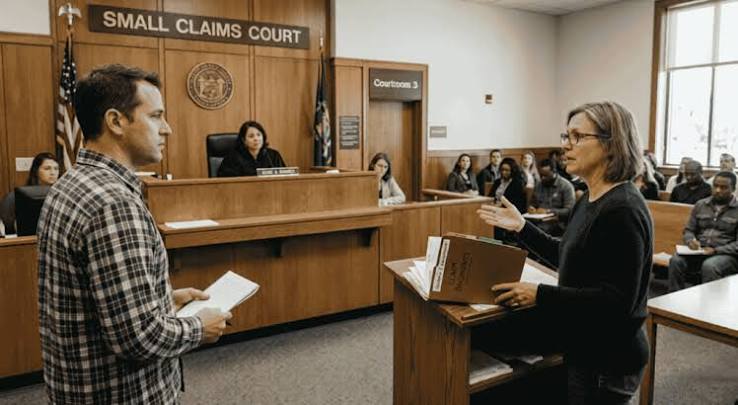
Picture something practical, not dramatic. A hearing room. A few papers. Maybe a clipboard. Small claims is usually much more ordinary than people expect, though the process still has enough formality that details matter.
For a filed case, the case usually starts with a claim form or complaint. You explain who owes what, why they owe it, and how much you want. Then the other side gets notified and has a chance to respond. After that, some courts set a hearing quickly; others put the matter through mediation or a settlement conference first.
When the other side does not respond, you may be able to ask for a default judgment, depending on the rules where you are. For a response, you may get a short hearing before a judge or magistrate. In many small claims courts, there is no jury. In some places, lawyers are limited or not allowed in the hearing itself, though that varies.
Here is the typical workflow:
- Prepare a short statement of your claim and gather supporting documents.
- File the papers with the court that has jurisdiction over the dispute.
- Pay the filing fee or request a fee waiver if your court offers one and you qualify.
- Serve the defendant using the method the court requires.
- Wait for a response, a mediation date, or a hearing date.
- Bring organized copies of your evidence to the hearing.
- Answer the judge’s questions clearly and stick to the facts.
- If you win, learn the collection rules; a judgment may need separate collection steps and is not always paid voluntarily.
And here is the part people miss: winning a judgment and getting paid are not the same thing. When the other side has the money and wants to resolve it, great. When not, you may need separate collection steps.
For a process that is flexible, cheap, and informal, small claims can work. For discovery, depositions, and long legal motions, this is not that court.
Quick check: For a case you can explain in a few pages and prove with documents, small claims is in the right neighborhood. For one that needs a deep paper trail and technical motion practice, it is probably not.
How to Prepare So You Do Not Waste a Filing

Preparation decides whether the case feels manageable or chaotic. I would not file until I had a clean folder of evidence and a one-paragraph theory of the case.
Start with proof of the deal. That may be a written contract, an invoice, a receipt, a text thread, an email chain, or a work order. Then gather proof of performance and nonperformance: you paid, they delivered late, they caused damage, they kept the deposit, or they ignored your demand.
For a dispute about property damage, photos matter. For one about money owed, bank records and invoices matter. For a service that was not done properly, before-and-after photos, timeline notes, and the original scope of work matter. I would also keep a short timeline with dates and names. A judge should be able to read it fast.
A good pre-filing sequence looks like this:
- Write a one-sentence version of what happened.
- List every document that supports that sentence.
- Sort the documents by date.
- Remove duplicates and keep only readable copies.
- Send a final written demand if that makes sense in your jurisdiction and situation.
- Identify the correct legal name of the defendant.
- Check whether the defendant is an individual, a business, a landlord company, or a contractor entity.
- Make copies for the court and for the other side.
Do not overbuild the case. You do not need a binder of every text message you have ever exchanged. You need the messages that prove the key points. Judges in small claims often want the short version first and the backup only when asked.
For a story you cannot tell simply, that is a sign to pause and refine it. For one you can tell clearly but cannot prove, you may still have a dispute, but a court case may be a harder road.
Quick check: For a claim you can state, back up with a few strong documents, and explain the money amount without guessing, you are ready to think about filing.
What Happens at the Hearing and Afterward
At the hearing, expect something practical rather than theatrical. You may sit in a courtroom, a conference room, or a hearing room. The judge will usually want a short summary, then documents, then direct answers. For witnesses are allowed and relevant, bring them only if they can help with a real disputed fact.
When the other side shows up and disputes the case, the judge may ask pointed questions: What was promised? What was paid? What was delivered? What proof do you have? That is normal. For drifting into argument or emotion, you usually lose the judge’s attention fast.
For a win, ask how the judgment is entered and what the next collection steps are. For a loss, find out whether there is any appeal or motion option in your jurisdiction and what the deadline is. Those deadlines vary, so check the official court notice immediately.
A few things to expect after the hearing:
- The judge may decide right away or later.
- You may get only part of what you asked for.
- The court may split costs in a limited way, depending on local rules.
- You may still have to collect the money yourself.
This is the part many generic guides get wrong: small claims is not just “file and wait for a check.” It can be a useful pressure point, but it is not magic. For the other side to have no money, the judgment may be hard to collect. When they are willing to pay once served, the case may settle before the hearing.
Quick check: For someone ready to talk briefly, present documents clearly, and accept that judgment enforcement may be a separate step, you understand the real shape of small claims.
When the Standard Advice Is Wrong
When your case has one of these wrinkles, the usual “just file in small claims” advice can miss the mark.
| Situation | Best Path | Why Other Options Fail |
|---|---|---|
| The defendant lives or is based in another place | Check jurisdiction and service rules first | Filing in the wrong court wastes time and may lead to dismissal |
| You need to sue a business with a complex ownership structure | Identify the legal entity before filing | Suing the trade name instead of the actual entity can derail the case |
| The dispute is partly about money and partly about an order to do something | Consider a different court or remedy | Small claims often cannot give the full remedy you want |
| The debt is old | Check local limitation rules before filing | A stale claim may be barred even if it feels morally fair |
| The problem is a repeat pattern, not one event | Document the pattern and ask whether small claims can handle it | A single-incident forum may not suit a broader dispute |
| You need emergency relief | Small claims is usually the wrong tool | Emergency orders usually require a different process |
When the other party is a tenant, landlord, contractor, platform seller, insurer, or former employer, the exact path can shift a lot by jurisdiction. That is why I would never rely on a one-size-fits-all small claims article for a real case. The label “small claims” hides a lot of local detail.
Because of that, the hard truth is that small claims is best when the issue is narrow. The more moving parts your dispute has, the less comfortable I am with treating it as a simple filing problem, so consult a qualified professional if the facts or remedies are not clear. Sources such as the Civil Justice Council in the UK and state court self-help pages in the U.S. explain that small-claims procedures are intended for simpler disputes, not multi-issue litigation.
Quick check: When your case involves another state, a business entity, an old debt, or a request for more than money, slow down and verify the local rules before you file.
Good Alternatives If Small Claims Is Not the Best Fit
For small claims to be not right, you still have options. The best alternative depends on what you actually want.
For payment, a written demand letter or settlement offer may be enough. For a simple dispute but the amount is near the small claims limit, mediation can save time and keep the relationship intact. For a higher amount, complex facts, or broader relief, a regular civil case may be the proper route. For an issue with a licensed professional, landlord, insurer, bank, or platform, a complaint to the relevant regulator or internal dispute process may also help.
Here is how I would choose:
- Demand letter if the other side may pay once they see you are serious.
- Mediation if both sides want a faster, less hostile fix.
- Small claims court if the dispute is narrow and mostly about money.
- Higher court or lawyer-led process if the case is legally dense or the remedy is broader.
- Administrative complaint if a regulator or business process can pressure the other side.
Small claims is attractive because it looks cheaper and simpler. Fair enough. The drawback is that it can also be too limited for some disputes and too slow for people who want a quick resolution. For comparing options, the practical question is not which forum sounds easiest; it is which forum is most likely to get the result you actually need.
